Security teams need coverage across multiple domains. Static analysis catches code flaws. Dependency scanning finds open-source vulnerabilities. Secrets detection prevents credential leaks. Cloud posture management stops misconfigurations.
SonarQube covers SAST, secrets, and IaC scanning. SCA requires the Advanced Security add-on. Infrastructure posture management is missing entirely. Teams must piece together separate tools for complete coverage.
The platforms below handle all four domains in one experience. They reduce tool sprawl. They provide unified visibility. They help teams prioritize what matters. These are the best platforms among SonarQube alternatives for organizations needing comprehensive security coverage.
1. Aikido
Aikido pulls everything into one platform. SAST, SCA, secrets, IaC, containers, cloud posture, DAST, and runtime protection. All of it. The company hit unicorn status in 2025 with a $1 billion valuation. Over 100,000 teams are on board. The Premier League trusts the platform. Revolut depends on it. SoundCloud has adopted it as well.
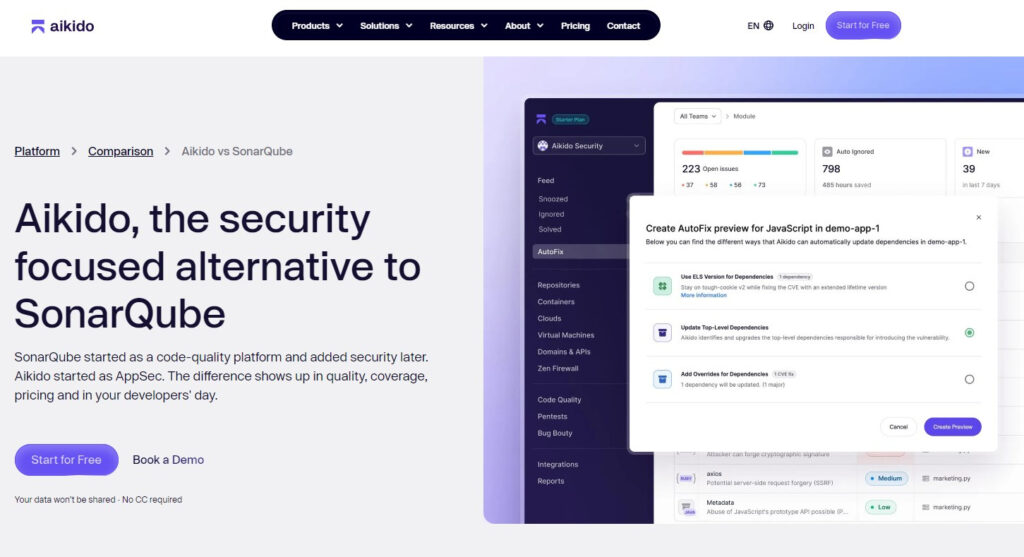
Here is where things get interesting. Reachability analysis checks every finding. If a vulnerability never gets called in the code, the alert never appears. AutoTriage validates whether something is actually exploitable. The result? Up to 95% fewer unnecessary alerts. AI AutoFix creates pull requests automatically. Fixes go straight into the developer workflow.
Cloud posture runs on autopilot. Continuous checks scan for misconfigurations. Overly permissive IAM roles get flagged. Compliance gaps get surfaced. Every finding maps to SOC2, ISO27001, CIS, or NIS2 controls. No manual mapping required.
Security coverage across domains:
- SAST with multi-file analysis, taint analysis, and custom rules
- SCA with reachability analysis and license compliance
- Secrets detection across the entire SDLC
- CSPM with continuous misconfiguration checks
This makes Aikido a SonarQube alternative firm that covers what SonarQube misses without requiring additional tools.
2. Prisma Cloud
Prisma Cloud comes from Palo Alto Networks. The platform covers security and compliance across applications, data, and infrastructure. Hybrid clouds. Multi-cloud environments. All of it. GigaOm named Prisma Cloud a leader in the inaugural CNAPP Radar. The platform scored highest in CIEM, asset visualization, and risk prioritization.
IaC scanning runs before deployment. Misconfigurations get caught early. SCA uses the “Technical DNA” feature. This captures programming languages, frameworks, and CI/CD pipeline info. Secrets detection finds exposed credentials in code and IaC templates.
Infrastructure posture management runs continuously. Visibility spans cloud resources. Compliance monitoring covers CIS and PCI DSS frameworks. Attack path visualization shows how vulnerabilities connect. Least-privilege access enforcement reduces risk.
Security coverage across domains:
- Infrastructure as Code scanning for SAST coverage
- Software Composition Analysis with dependency mapping
- Secrets detection with advanced signatures
- CSPM with attack path visualization
For organizations comparing SonarQube alternatives for the cloud, Prisma Cloud delivers enterprise-grade CNAPP capabilities.
3. Qualys
Qualys TotalCloud brings multiple security functions together. CSPM, CWPP, CIEM, CDR, KCS, IaC, and DSPM. All under one license. The platform won Best Cloud Security Solution at the SC Awards Europe 2025. The judging panel called it “An impressive infrastructure security solution with comprehensive protection, clear cost efficiency, and effective risk management across diverse environments”.
TruRisk does the heavy lifting. One score correlates vulnerabilities, misconfigurations, identity risks, runtime threats, and AI exposures. Everything in one view. UBS Financial reported significant security improvements after six months of using the platform, solving problems related to asset management, cloud configuration, and new asset identification.
Qualys scans IaC templates before anything gets deployed. That covers the SAST side. Software Composition Analysis (SwCA) handles the SCA piece. Open-source and commercial components get scanned for vulnerabilities. Secrets detection runs on container images. Hard-coded credentials get flagged.
FlexScan powers the infrastructure posture piece. Agentless scanning. Agent-based scanning. Snapshot scanning. Three approaches combined into one system. The platform ships with pre-built policy frameworks. CIS. PCI-DSS. HIPAA. NIST. All covered out of the box.
Security coverage across domains:
- Security coverage across domains:
- IaC scanning before deployment
- SCA with TruRisk prioritization
- Secrets detection in container images
- Infrastructure posture with multi-environment coverage
For enterprises looking for SonarQube alternatives for the cloud, Qualys provides mature CNAPP capabilities with compliance-focused features.
Why SAST, SCA, Secrets & Cloud Posture Belong Together
Security teams often treat these four domains as separate concerns. Code scanning is one team’s responsibility. Dependency scanning belongs to another. Secrets detection and cloud posture are handled by different tools. The result is fragmentation.
SAST catches code-level vulnerabilities
SAST tools look for injection flaws, cross-site scripting, and memory corruption issues. Aikido ships with built-in CVE database scanning. Prisma Cloud runs IaC checks before any template gets deployed. Qualys does the same – infrastructure code gets scanned before it ever touches production.
SCA manages open-source risk
SCA tools dig into third-party components. Libraries, frameworks, and dependencies get scanned. Aikido takes it further with reachability analysis. False positives get filtered out. Remediation advice comes built-in.
Prisma Cloud’s “Technical DNA” feature maps everything. Application dependencies get inventoried and visualized. Qualys scans for open-source and commercial software components. Vulnerabilities get discovered and prioritized.
Secrets detection prevents credential leaks
Secrets detection identifies exposed credentials, API keys, and tokens. Aikido scans across the entire SDLC. Prisma Cloud’s Application Security module detects secrets declared in code. Qualys scans container images for hard-coded secrets.
Cloud posture management stops misconfigurations
Infrastructure posture tools scan for misconfigurations. Overly permissive IAM roles get flagged. Compliance gaps get surfaced. Aikido runs continuous checks mapped to SOC2, ISO27001, CIS, and NIS2 controls. Prisma Cloud provides visibility and compliance monitoring across environments. Qualys ships with pre-built policy frameworks for major compliance standards.
The fragmentation problem
When these domains are handled by separate tools, teams face several challenges. Duplicate findings appear across platforms. Prioritization becomes inconsistent. Remediation workflows are disconnected. Compliance reporting requires manual consolidation.
Unified platforms solve this
Aikido’s platform-level alternative covers code, dependencies, infrastructure, containers, applications, and cloud in one experience. Prisma Cloud provides end-to-end security from code to cloud. Qualys drives real-time, measurable risk reduction using FlexScan for multi-environment coverage.
For organizations comparing SonarQube alternatives for containers, unified platforms reduce tool sprawl and improve remediation efficiency.
How to Choose Based on Coverage Needs
The right platform depends on team size, security requirements, and deployment preferences.
Teams wanting all-in-one coverage
Aikido combines SAST, SCA, secrets detection, IaC scanning, container security, posture management across environments, DAST, and runtime protection in a single platform. Free tier with 2 users and 10 repos. Paid plans start at €300/month flat for 10 users. For teams looking for SonarQube alternatives for cloud and containers, Aikido covers both without extra fees.
Enterprises with complex infrastructure
Prisma Cloud handles complex deployments. Container lifecycle security runs deep. Infrastructure posture management runs alongside it. CIEM capabilities calculate net-effective permissions. Least-privilege recommendations come built in. For organizations comparing SonarQube alternatives for containers, Prisma Cloud delivers enterprise-grade protection.
Enterprises needing compliance-focused coverage
Qualys TotalCloud ships with pre-built policy frameworks. CIS, PCI-DSS, HIPAA, and NIST are all covered. TruRisk scoring prioritizes verified, attackable exposures. Compliance reporting comes standard. Enterprises looking for SonarQube alternatives for infrastructure security often choose Qualys for its compliance features.
Conclusions
SAST, SCA, secrets detection, and infrastructure posture management belong together. Separate tools create fragmentation. Duplicate findings waste time. Inconsistent prioritization hides real risks. Compliance reporting becomes manual and error-prone.
Aikido combines all four domains in one platform. SAST catches code-level vulnerabilities. SCA tracks open-source risk. Secrets detection prevents credential leaks. Cloud posture monitoring stops misconfigurations. AutoTriage reduces alert noise by up to 95%. AutoFix generates pull requests automatically. The platform’s reachability analysis filters out unreachable vulnerabilities. For teams looking for a SonarQube alternative firm with comprehensive coverage, Aikido delivers.
Prisma Cloud provides enterprise-grade CNAPP with CIEM, attack path visualization, and IaC scanning. Qualys offers compliance-focused cloud security with TruRisk prioritization and multi-environment coverage.
Among all-in-one SonarQube alternatives to consider, Aikido stands out for coverage breadth and noise reduction. Prisma Cloud and Qualys serve enterprise needs with specialized capabilities. The best choice depends on team size and security requirements. But for comprehensive security from code to cloud, unified platforms deliver the most value.